

Impact Measurement
Monival M&E Platform
Monitor, Evaluate, and Optimize Your Development Programs
M&E solution for NGOs and development organizations.
Key Capabilities
What Monival M&E Platform Delivers
Projects & Grants Management
Mobile Data Collection (ODK)
GIS & Mapping Integration
Logframe & Theory of Change
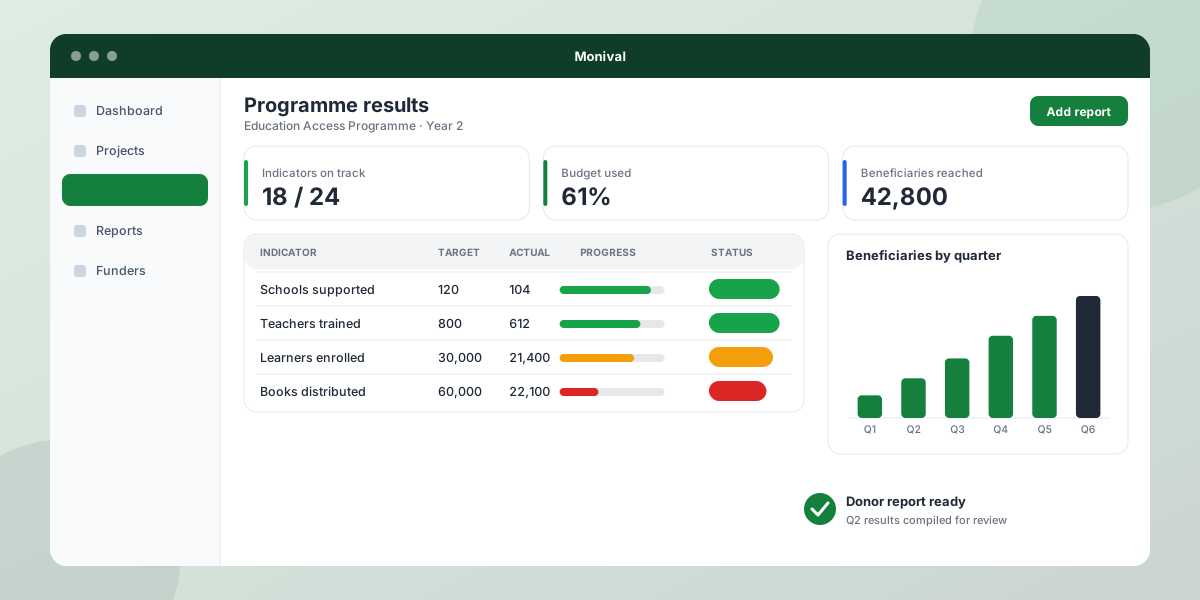
Automated Donor Reporting
Multi-country Program Tracking
Monival pricing
Start free with a pilot. Pay when the programme grows, not before.
Local currency amounts are indicative. Your quote confirms the final price.
Community
Free for pilots and small M&E teams.
Free
- Up to 3 forms
- 100 submissions a month
- 5 enumerators
- Offline mobile app
Professional
For growing programmes and research teams.
$3,600
per year
about $300 a month, billed annually
USD list price: $3,600 a year
Non-profit and academic: $2,500 a year
- Unlimited forms and enumerators
- 10,000 submissions a month
- Offline mobile app
- 360 degree evaluation engine
- Power BI and OData feed
- Webhooks and API access
Premium
For large or multi-country programmes that need service levels.
From $12,000
per year
about $1,000 a month, billed annually
USD list price: from $12,000 a year
- Everything in Professional
- Custom submission limits
- Dedicated onboarding
- SLA and priority support
- Grants plan: Professional plus the grants and donor-reporting module (from $2,400 a year), so from $6,000 a year. Early access: ask for the waitlist.
- Billed annually. Monthly billing, where offered, costs 20% more.
- Non-profit and academic organizations get 30% off subscriptions after a quick verification.
- Prices exclude VAT (16% in Kenya) and withholding tax.
- Prices are in US dollars. Local currency amounts are indicative; your quote confirms the final price.
Not sure which fits? Tell us your team size and what you use today and we will point you to the right option.
Who Monival is for
- NGOs and development organizations reporting to institutional donors, where the reporting format is not negotiable and the data has to reconcile across multiple grants.
- Government programmes and agencies tracking indicators against a national or sector framework, including the Global Goals.
- Foundations and funders monitoring a portfolio of grantees, who need comparable data from organizations of very different sophistication.
- Programmes collecting data in the field, often offline, where the current method is a spreadsheet emailed monthly from each site and reconciled by hand.
What a Monival deployment covers
Monival is our platform, so the engagement is about encoding your results framework rather than building software. The quality of that framework largely determines the quality of what comes out.
- Your results framework configured, indicators, baselines, targets, disaggregation and the logic linking activity to outcome.
- Data collection forms for each level of the programme, including offline capture for field teams with intermittent connectivity.
- Validation rules, so implausible data is caught at entry rather than discovered at reporting.
- Donor report templates matching the formats you are actually required to submit.
- Dashboards for programme managers and for the board, which are not the same audience and should not be the same dashboard.
- Training for field enumerators, M&E officers and programme leadership, each to a different depth.
How the engagement runs
- 1
Framework review
We go through the logframe or theory of change with your M&E team. Where indicators are unmeasurable as written, and some usually are, that surfaces here, which is uncomfortable and much cheaper than finding out mid-cycle.
- 2
Configuration
Indicators, forms, validation and reporting templates are built and tested against a completed reporting period you already know the answers for.
- 3
Field pilot
One site or region collects live, including on the connectivity they actually have rather than the connectivity the plan assumes.
- 4
Rollout and training
Remaining sites onboard, with enumerator training closest to the point of use.
- 5
First reporting cycle
We stay close through the first full donor report, because that is the real test of the configuration.
What you need in place
- A results framework or logframe. If one does not exist, that work comes first, Monival measures against a framework and cannot substitute for one.
- Clarity on donor reporting requirements, including the formats and deadlines you are contractually bound to.
- A named M&E owner with authority over indicator definitions. Where each programme defines "beneficiary" differently, data will not aggregate.
- Realistic information about field connectivity and the devices enumerators actually carry.
Working with Sibasi on Monival
Can Monival handle several donors with different reporting formats?
Yes, and this is usually the reason organizations move to it. The underlying data is collected once against your own framework, and donor-specific reports are generated as views over that data. The alternative most organizations are living with is collecting the same information several times in several shapes, which is where reconciliation errors come from and where the M&E officer loses most of their week.
What happens where field teams have no connectivity?
Data is captured offline on the device and synchronizes when a connection is available. This is a normal operating mode rather than an edge case, and we test it during the pilot on the connectivity the sites genuinely have. Programmes that assume connectivity and discover otherwise at rollout lose a reporting cycle to it.
Our indicators are not well defined. Is that a problem?
It is the problem, and it is better to know now. Configuring a system forces every indicator to have a precise definition, a numerator, a denominator and a disaggregation. Where that does not exist, the framework review surfaces it, and some organizations use the deployment as the occasion to fix a logframe that has been quietly unmeasurable for years. It adds time, and it is time you would have spent anyway.
Who enters the data?
Whoever is closest to it, which is the point. Field enumerators capture at the point of activity, programme staff review and validate, and M&E aggregates. A system where one M&E officer re-keys everything from paper reproduces the bottleneck you are trying to remove, so the rollout puts collection where the activity happens and concentrates training there.
Can our board see programme data without seeing everything?
Yes. Board and management dashboards are configured separately because they answer different questions, a board wants portfolio-level outcome movement and exceptions, a programme manager wants this month’s site-level completeness. Building one dashboard for both audiences reliably serves neither.
Let's put Monival M&E Platform to work for you
Talk to our specialists about your goals, timeline and budget.
Talk to an Expert